Thứ Năm, 8 tháng 12, 2016

How many facts did you know about Dove?

How many facts did you know about Dove? I love to know and share amazing information about Dove as this below article.

#1

Dove can get easily adjusted in almost every kind of environment. So, we can find they everywhere except the truly harsh areas, like desert and Antarctica. How much do you know about tiger facts for kids ?


#2

Like all birds, Mourning Doves are unable to sweat, so to stay cool during hot weather. They pant just like a dog. Panting requires the doves to drink a great deal of water due the excessive loss of moisture to evaporation.

#3 

Mourning Doves produce a mournful cooing sound which is probably responsible for its memorable common name.

#4 

The names Pigeon and Dove are often used interchangeably. That might be one of the most awesome animal facts you had no idea before. In fact, in many languages, these terms are translated exactly the same. Pigeons and Doves belong to the same family, Columbidae, and have many similar features.

#5 

In Christianity, the dove is a common Christian symbol to embody the Holy Spirit. The Christian symbol of a dove with an olive branch in its beak represents peace.

#6

As with most birds, doves will primarily feed on seeds, nuts and fruits. Interesting, the species can actually be divided in terms of doves that primarily feast on seeds (granivorous) and the other family of dove, the frugivorous species, where fruit is the primary source of nutrition.

#7

Doves and Pigeons have no gall bladder. Although the reason behind this anomaly in unknown, interestingly, these birds still produce bile.

#8 

Both the male and the female produce milk for their young. Their milk is called crop milk. It contains a higher level of protein and fat than the milk produced by mammals.

#9 

Life span of dove in the wild is 1.5 years for adults. However, doves lifespan in captivity can exceed 20 years. Check out my list of fun, weird and just plain amazing fact of life I have found.

#10

When they lay eggs, it is usually just two. Incubation takes just two weeks.

Chủ Nhật, 20 tháng 11, 2016

Why Pigs Need Mud

Why Pigs need mud? Can you give us the best explaination? If you can't, let's find out here to know and also get other fact of life I have found as below


Pigs roll in mud primarily in order to regulate their body temperature. This behavior is more commonly referred to as "wallowing."

As well as offering protection from the sun's rays, a coating of moist mud is crucial for keeping pigs cool in warm weather through gradual evaporation. This method is so effective that some have suggested wallowing as the reason for the limited evolutionary development of sweat glands in pigs. Pigs also wallow in cooler weather, indicating additional motivations such as the removal of parasites, and possibly marking territory with scent. Of course, pigs also genuinely enjoy wallowing for its own sake, showing signs of distress when farmers attempt to curb their behavior with anti-parasite medicines or air-conditioned barns.
How much do you know about tiger facts for kids? Let’s check.

Thứ Năm, 17 tháng 11, 2016

A wide range of Pangolin facts

Below is a wide range of Pangolin facts and their physical characteristics


Pangolin species vary in size from about 1.6kg (~3.5 lbs) to a maximum of about 33kg (~73 lbs). They vary in color from light to yellowish brown through olive to dark brown. Protective, overlapping scales cover most of their bodies. That might be one of the most awesome animals facts you had no idea before. These scales are made from keratin — the same protein that forms human hair and finger nails. Overlapping like artichoke leaves, the scales grow throughout the life of a pangolin just like hair; scale edges are constantly filed down as pangolins dig burrows and tunnel through the soil in search of termites and ants. Pangolin undersides do not have scales, and are covered with sparse fur. Unlike African pangolins, Asian pangolins also have thick bristles that emerge from between their scales.

With small conical heads and jaws lacking teeth, pangolins have amazingly long, muscular, and sticky tongues that are perfect for reaching and lapping up ants and termites in deep cavities. Pangolins have poor vision, so they locate termite and ant nests with their strong sense of smell. A pangolin’s tongue is attached near its pelvis and last pair of ribs, and when fully extended is longer than the animal’s head and body. At rest a pangolin’s tongue retracts into a sheath in its chest cavity. A pangolin’s stomach is muscular and has keratinous spines projecting into its interior. Usually containing small stones, the stomach mashes and grinds prey in much the same manner as a bird’s gizzard. Wanna take a quick look at funny pictures with captions that can help you relax effectively.


Pangolin limbs are stout and well adapted for digging. Each paw has five toes, and their forefeet have three long, curved, claws used to demolish the nests of termites and ants and to dig nesting and sleeping burrows. Pangolins shuffle on all four limbs, balancing on the outer edges of their forefeet and tucking their foreclaws underneath as they walk. They can run surprisingly fast, and will often rise on their hind limbs to sniff the air. Pangolins are also capable swimmers, and while some pangolin species such as the African ground pangolin (Manis temmincki) are completely terrestrial, others, such as the African tree pangolin (Manis tricuspis), are adept climbers, using their claws and semi-prehensile tails to grip bark and scale trees.

How much do you know about tiger facts for kids? Let’s check.

Thứ Hai, 7 tháng 11, 2016

Facts and infor about seed plants

Facts and infor about seed plants are all shown here. Let's have a view at it now.


INSIDE A SEED

A seed is the first stage in the life cycle of a plant. Protected inside the tough seed coat, or testa, is the baby plant, called an embryo. Food, which fuels germination and growth, is either packed around the embryo or stored in special seed leaves, called cotyledons.

SPREADING WITHOUT SEEDS

Seeds are not the only means of reproduction. Some plants create offshoots of themselves – in the form of bulbs, tubers, corms, or rhizomes – that can grow into new plants. This type of reproduction is called vegetative reproduction. As only one parent plant is needed, the offspring is a clone of its parent. This might be one of the most weird facts about them.
 
Bulb

A bulb is an underground bud with swollen leaf bases. Its food store allows flowers and leaves to grow quickly. New bulbs develop around the old one.

Tuber

A tuber is a swollen stem or root with buds on its surface. When conditions are right, the tuber’s food store allows the buds to grow. Still boring? Check out our funny images to get relaxing moments in your freetime.
 

Corm

A corm is a swollen underground stem that provides energy for a growing bud. After the food in the old corm is used up, a new corm forms above it.

Rhizome

A rhizome is a horizontal stem that grows underground or on the surface. It divides and produces new buds and shoots along its branches.

GERMINATION OF A RUNNER BEAN

Most seeds require damp, warm conditions in order to sprout. During germination, the seed absorbs water and the embryo starts to use its food store. A young root, or radicle, begins to grow downward. Then a young shoot, or plumule, grows upward. This develops into the stem and produces leaves. The first leaves, called seed leaves or cotyledons, fuel the early growth until the plant’s true leaves appear.

FRUITS

A flower’s ovary usually develops into a fruit to protect the seeds and help disperse them. A fruit may be succulent (fleshy) or dry. Fruit is often tasty and colourful to attract fruit-eating animals. Its seeds can pass through an animal unharmed, falling to the ground in droppings. Seeds may also be dispersed on animals’ coats, by the wind, or by the fruit bursting open.

DRY FRUITS

The seeds of dry fruits are dispersed in various ways. Peapods are dry fruits that split and shoot out their seeds by force. The hogweed fruit forms a papery wing around the seed, helping it to float on the breeze. The strawberry is a false fruit, but it is covered by tiny dry fruits, each with a seed.


SUCCULENT FRUITS

Fleshy, brightly coloured, and often scented, succulent fruits are designed to attract the animals that eat and disperse them. Fleshy fruits such as apricots and cherries have a woody stone or pip that protects the seed. Called drupes, these fruits form from a single ovary. Many drupes, formed from many ovaries, may cluster to form a compound fruit, such as a raspberry.

If you have a keen interest in amazing science facts, keep subcribing our site to get more information about this aspect.

Thứ Hai, 31 tháng 10, 2016

Science facts that you had no idea until now

Keep reading for more interesting information about amazing science facts that you had no idea until now

1. There are thousands of other planets out there.

We have eight planets in our Solar System. However, outside of our Solar System there are thousands of other planets. The extra-solar planets or exo-planets are in orbit around another star. So far we have almost 1800 confirmed new worlds, with another 3000 awaiting confirmation. Astronomers are looking to a star’s goldilocks zone for planets that may be habitable, just like the Earth. The majority of planets discovered so far are hot gas giant planets.


There are thousands of planets out there! This artist’s impression shows what those multiple Solar Systems might look like. (Image Credit: NASA/ESA/ESO)

2. In space the skin on your feet peels off!

This is a pretty gross fact but in the micro-gravity environment, astronauts are not using their feet to walk. Therefore the skin on their feet starts to soften and flakes off. As laundry facilities do not exist in space, astronauts will wear the same underwear and socks for a few days. Those socks then need to be taken off very gently. If not those dead skin cells will float around in the weightless environment.

3. On Venus a day is longer than a year.

This is tricky one to get your head around but a year on Venus (that is the length of time it takes to complete one whole orbit around the Sun) is 224.7 Earth days. However it takes 243 Earth days to rotate on its axis just once.

4. The astronauts were placed in quarantine after returning from the moon.

There is a famous image of President Nixon talking to the Apollo 11 crew consisting of Michael Collins, Neil Armstrong and Buzz Aldrin. This continued until after the Apollo 14 crew returned safely. After this it was decided that the Moon did not contain any deadly diseases. The Apollo 13 crew, who had a malfunction and had to return to Earth, did not have to be quarantined after their re-entry as they didn’t actually walk on the moon. This is one of the most amazing facts ever.


5. One million Earths can fit inside the Sun.

Ancient astronomers once believed the Earth was at the centre of the Universe but now we know that the Sun is at the centre of our Solar System and our planets orbit the Sun. The Sun makes up 99.8% of the entire mass of the whole Solar System. One million Earths would be needed to be the same size as the Sun.


6.You become taller in Space.

Another change to the human body in micro-gravity is that spine straightens out, as gravity is not pushing you down. In fact you can be up to as much as 5cm taller in the Space Station.

7. Extreme weather warning!

Some times on the Earth, especially here in Northern Ireland the weather can be a bit rubbish! However our weather is awesome compared to some of the other planets. Jupiter has fast winds and the Great Red spot, a massive hurricane style storm, has raged there for the last 300 years. Mercury and Mars have extreme temperature changes in the same day. Venus is a scorching five times hotter than boiling water. Saturn and Uranus also have extremely fast winds. However Neptune has the fastest ever wind speeds reaching a staggering 1600mph!


Neptune the windiest planet as captured by Voyager 2 in 1989. (image Credit: Voyager 2, NASA)

8. Space is not that far away.

Space officially begins at the universal marker of the Karman Line. This invisible boundary is 100km above the Earth. In theory if you could drive your car upwards, you could be in space in less than hour.

Check out for more cool, random, weird but true, crazy, fun, amazing facts, fact of life, fact of the day, and funny videos, video clips, funny pics, images, photos.

Thứ Năm, 27 tháng 10, 2016

A list of interesting rainbow facts

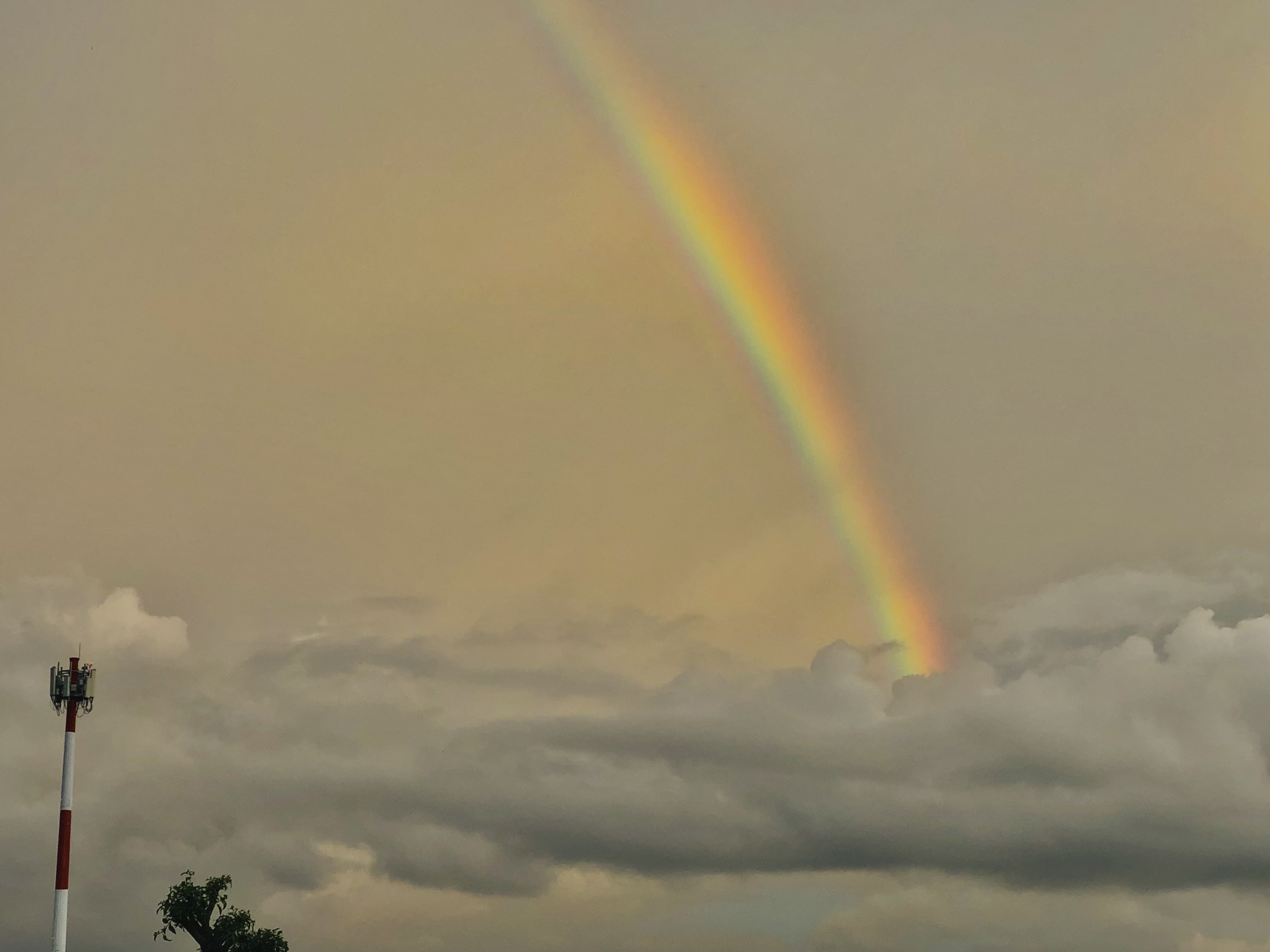
How much did you know about science facts? Can you list interesting rainbow facts? Keep reading to know. A rainbow is a meteorological phenomenon that is caused by reflection, refraction and dispersion of light in water droplets resulting in a spectrum of light appearing in the sky. It takes the form of a multicoloured arc. Rainbows caused by sunlight always appear in the section of sky directly opposite the sun.


Fact #1

A rainbow is a multi-colored arc that forms in the sky.

Fact #2

How do rainbows form? Rainbows are created by both reflection and refraction (bending) of light in water droplets in the atmosphere, which results in a spectrum of light appearing.

Fact #3

The main rainbow colours in order are Red, Orange, Yellow, Green, Blue, Indigo, and Violet (the acronym or name ROY G BIV is also a good way to remember these colors as well as their order). Sir Isaac Newton identified the 7 colors of the visible spectrum that together make up white light. And all of which are present in a rainbow in the order ). Legend has it that Newton included indigo because he felt that there should be seven rather than six coloursin a rainbow because of his strong religious beliefs.

Fact #4

These 7 colours in the rainbow are just the main ones. Actually, a rainbow is made up of an entire range of colours, any colour you have ever seen, even colours you haven’t seen! Nobody sees colors the same, our eyes react differently depending on how much light there is. Therefore, some people may see more colors than what you see. This is one of the most amazing factswe've heard. 

Fact #5

In fact, a rainbow is a full circle of light. However, because of most people viewing a rainbowon the ground, we can only see a semi-circle or arc of the rainbow.

Fact #6

A "double rainbow" is where a second, much fainter arc can be seen outside of the primary arc. This is caused by the light reflecting twice inside the water droplets. As a result of this double reflection the colors of the second arc are inverted with violet on the outer edge and red on the inner edge.


Fact #7

No two people see the same rainbow. If someone appears to be standing under a rainbowyou can see, they will see a different rainbow at the same angle but further away.

Fact #8

A rainbow is not an object so it can’t be approached or physically touched.

Fact #9

Rainbows can be seen not just in the rain but also in the mist, in the spray of water from the ocean, fog, and dew, whenever there are water drops in the air and light shining from behind at the right angle.

Fact #10

Rainbows can also be seen during night-time. Moonlight can produce enough light to create a rainbow at night. This is a “lunar rainbow” or “moonbow”. Moonbows are rare because moonlight is not very bright.


Fact #11

A rainbow is not situated at a specified distance, instead it will always be visible to a person at the precise angle freshwater droplets reflect the light which is 42 degrees in the opposite direction of the sun.

Fact #12

A "fogbow" is formed by cloud and fog droplets, they are almost white with very faint colors visible. Fogbows are quite large and much broader than a rainbow. Here're not jokes to be funny, it's the truth.

Fact #13

An old European belief is that anyone passing underneath a rainbow would be changed from a man into a woman or vice versa. The idea that a pot of gold can be found at the rainbow’s end originated in old Europe. In a place called Silesia it was said that the angels put the gold there and that only a nude man could obtain the prize. Unfortunately, scientists says this is impossible to do.

Fact #14

Rainbows are the universal symbol of peace and harmony.

Fact #15

Most rainbows we see will be a "primary rainbow" whereby the red colour can be seen on the outer edge through to violet on the inner edge.

Thứ Ba, 25 tháng 10, 2016

World Series quick facts that will amaze you

Let's check out our rich source of World Series quick facts, sport facts

1. Championship Game Predates World Series


Prior to the first World Series in 1903 and from 1884-1890, an Exhibition Series occurred between the champions of the National League and the American Association (a rival association that folded in 1891). The event was disorganized and thrown together by the teams themselves. Sometimes the Series lasted three games and others as many as 15. When the American Association dissolved, the National League continued as the only league.

2. Only one “world champion” team didn’t come from the United States

Despite the competition’s all-inclusive name, only one team not based in the United States has won the World Series: the Toronto Blue Jays, victors in both 1992 and 1993. Only one other international team—the now-defunct Montreal Expos—has ever even played in the major leagues, though they never appeared in the Fall Classic. Though there are talks of expanding into Mexico or other nearby countries (travel time makes a truly international sport difficult), an American “world champion” is a virtual guarantee for now.
Want to see funny pictures with captions, check out here now.

3. Only One No-Hitter

It is the fact that Yankees’ pitcher Don Larsen recorded the only no-hitter (in this case a perfect game) in World Series history during Game 5 of the 1956 Series.

4. Most Consecutive Scoreless Innings Pitched was 33

With 33 consecutive scoreless innings pitched, Whitey Ford holds the World Series record. Previously, the record holder was Babe Ruth, who pitched 29 2/3.

5. World Series was Cancelled Twice 

The player’s strike in 1994 cancelled that year’s Fall Classic, while a rivalry between the Boston Pilgrims and the New York Giants ended the 1904 Series. During World War II, the Series continued, however many of the best players fought overseas and were missing from the games. In 1943, the New York Yankees won the Series without Hall of Famers Joe DiMaggio, Phil Rizzuto, and Red Ruffing.

6. First Pinch-Hit Home Run was in 1947

Yogi Berra hit the first pinch-hit home run in World Series history in Game 3 of the 1947 World Series against the Dodgers’ pitcher, Ralph Branca. The Yankees lost the game, but won the Series in seven games.

7. Managers with 7 Wins had the Most in a World Series 

Former Yankee managers, Joe McCarthy and Casey Stengel, set the record with each winning seven World Series games during their managerial careers.

8. It’s a Small World


It may be called the World Series, but it doesn’t seem like the rest of the world gets to play. The Toronto Blue Jays are the only team outside the US to have won the World Series – they were back-to-back champions in 1992 and 1993.

9. Most Stolen Bases was in 1967

Super-fast Lou Brock from the Cardinals set the single-season record with seven stolen bases in the 1967 World Series and in 1968 he tied it. He also shares with Eddie Collins the largest number of career stolen bases in the World Series, 14.

10. Before Championship Rings, Players took Home Watches or Medallions

Since 1967, the winner of the World Series has received the Commissioner’s Trophy and traditionally each winning team has presented its members with championship rings. Previously, players were given pocket watches or medallions. In 1922, the New York Giants became the first team to issue rings.

Aboves are the selected facts on World Series from factoflife that can help you know more about this. Hopefully, this article will prod you to love and follow for this year’s final chapters of America’s beloved sport. At the same time, you can also have a look at our rich source of entertainment facts on interesting films, amazing arts, joke of the day, music types, spectacular games and much more.